
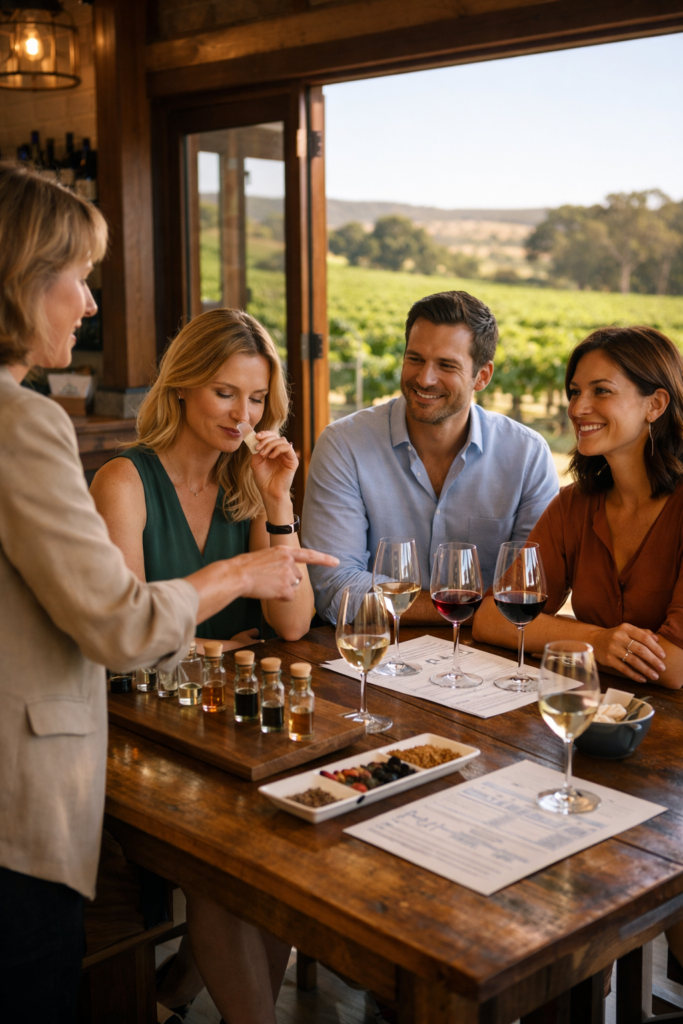
Guided Wine Tasting: A Different Way to Discover Wine
Most wine tastings follow the same pattern. You stand at a counter, a glass is poured, a few words are exchanged, and then the next wine arrives. While enjoyable, this format rarely allows people to truly understand what they are tasting.
A guided wine tasting takes a different approach. Instead of simply serving wines, the experience becomes a structured exploration of aromas, sensations and memory. Participants learn how to recognise what they smell and taste, transforming a casual tasting into a deeper sensory experience.
1. Learning to Use Your Nose
The human nose is capable of identifying thousands of aromas, yet most people rarely pay attention to them. A guided tasting begins by reconnecting participants with their sense of smell.
Through simple exercises, participants explore familiar aromas — fruits, herbs, spices and flowers. These scents form the building blocks of wine aromas. Once the brain recognises them individually, it becomes easier to identify them in a glass of wine.
2. Understanding Aromatic Families
Wine aromas are often grouped into families: fruity, floral, herbal, spicy or earthy. Rather than trying to guess exact descriptors, participants learn to recognise these broader aromatic categories.
This approach removes the pressure often associated with wine tasting. Instead of searching for the “correct answer”, participants simply train their perception and confidence.
3. Tasting with Structure
Once the nose has been prepared, the tasting begins. Each wine is approached methodically: appearance, aroma, texture, balance and finish.
Participants learn how acidity, tannins, alcohol and fruit concentration interact to create the structure of the wine. Understanding these elements allows people to move beyond simple preference and begin to appreciate why certain wines feel elegant, powerful or refreshing.
4. Wine as a Sensory Memory
Wine is deeply connected to memory. A smell can instantly bring back a place, a moment or a season. A guided tasting encourages participants to connect aromas with personal experiences.

This personal dimension makes wine more accessible and far more memorable. Instead of technical vocabulary, the experience becomes an exploration of sensation and memory.
A Guided Wine Experience in Swan Valley
Located just outside Perth, the Swan Valley offers an ideal setting for this type of tasting. Surrounded by vineyards and quiet landscapes, participants can slow down and focus on the sensory experience.
A guided wine tasting transforms a simple winery visit into something more thoughtful: an opportunity to rediscover how we smell, taste and remember.